Earth – the 3rd planet from the Sun, humanity’s home, and as far as we know, the only planet with an atmosphere with oxygen and oceans of water that supports life as we know it. So what makes this little planet so interesting, besides the fact that it is the only planet mankind has ever populated?
Earth is the 5th largest planet in our solar system. It is larger than the 3 other rocky planets Mercury, Venus and Mars, but smaller than Jupiter, Saturn, Uranus and Neptune, the gas giants of the system. Its diameter is close to 13,000 km, and because gravity pulls Earth into a sphere, it has a roundish shape. Earth’s shape is far from a perfect sphere, thanks to the planet’s spin, which squashes it at the poles and makes it look swollen at the equator.
The surface of the planet is covered 71% by water, most of it being in the oceans. While humans need oxygen to survive, only 21% of the atmosphere is made up of oxygen produced by plants, while 78% of it is made of nitrogen and 1% is other gases. Only in recent decades, scientists have discovered more facts about the Earth via pictures from space, though others have used various methods to get to know as much as possible about the planet we call home.
Characteristics
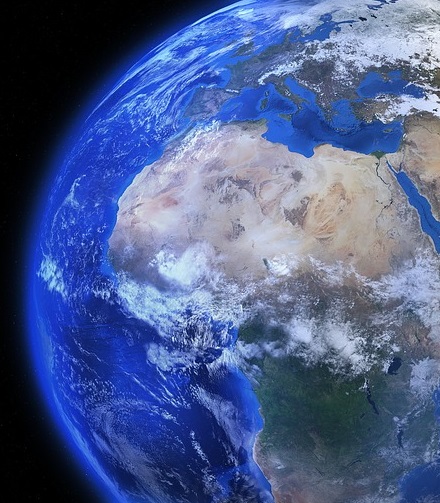 Earth spins on an axis running from the North Pole to the South Pole, while at the same time orbiting around the Sun. In 23.439 hours, Earth completes a full rotation on its axis, and it takes the planet 365.25 days to make a full trip around the Sun, which is the exact length of an Earth year.
The axis of Earth is tilted relative to the ecliptic lane, an imaginary lane on which Earth travels around the Sun. This makes the northern and southern part of the planet point away or toward the Sun, depending which time of the year it is, which additionally changes the amount of light Earth will receive from the yellow star and creates seasons on the planet.
The orbit of Earth is not a perfect circle, but its ellipse is more oval-shaped than round, similar to the orbits of the other planets in the system. The Earth is closest to the Sun in early January, and the farthest in July, with this having a lesser effect on the planet’s cooling and heating than the Earth axis tilting to the side. Earth is situated in the ‘Goldilocks zone’ around the Sun, giving it the perfect temperature and conditions to support life on its surface.
At an average, the Earth is 149,598,262 km away from the Sun at the farthest point of its orbit. At perihelion, its closest approach to the Sun, it is 147,098,291 km away from it and at aphelion, its farthest point from the Sun, it is 152,098,233 km removed from the star.
Formation & Evolution
It is widely believed by scientists that Earth was formed 4.6 billion years ago, around the same time as the Sun, when our solar system was formed from the remnants of a giant cloud of dust and gas that is known as solar nebula. Due to gravity, the solar nebula collapsed, spinning faster and flattening into the shape of a disk. Most of the material from the nebula formed the Sun in the center, with the other particles in the disk colliding and forming large celestial bodies, which is also how Earth was created. Powerful solar winds emitted from the Sun pushed most of the lighter elements like helium and hydrogen away from the worlds closest to the Sun, giving the first 4 planets in the system their small and rocky shapes.
It is believed that the Earth was first a massive rock without water. Eventually, the increasing pressure within the planet and radioactive materials in the rock created enough heat to melt the planet’s core, thus letting certain chemicals rise to the surface and forming water, with other elements forming the atmosphere’s gases. Scientists suggest that the crust and oceans on Earth were formed 200 million years after the planet got its shape.
Earth’s history can be divided into 4 eons, starting with the oldest, going to the youngest – Hadean, Archean, Proterozoic and Phanerozoic. The first 3 eons lasted for almost 4 billion years and are called the Precambrian. There is evidence that life existed as early as 3.8 billion years ago, during the Archean eon, but not until the Phanerozoic did life become more abundant on Earth.
The Phanerozoic eon can be divided into 3 eras – the Paleozoic, Mesozoic and Cenozoic. During the Paleozoic, Earth witnessed the development of all types of plants and animals, both on land and in the sea, while the Mesozoic is considered the era of the dinosaurs. The Cenozoic is the era we currently live in and is the age of mammals.
Roughly 65 million years ago, with the extinction of the dinosaurs came the age of mammals. The dinosaurs are believed to have been wiped out by a meteor that hit Earth and extinguished most species that couldn’t adept to the following change in climate. Those who survived the harsh conditions are now the dominant animals on the planet.
Composition and Structure of Earth
Atmosphere
The atmosphere of Earth is 78% nitrogen, 21% oxygen, with the rest being made up of water, argon, carbon-dioxide and other trace gases. Earth is the only known planet to have such an abundance of free oxygen, making it also the only planet with these unique characteristics that support life as we know it.
The air surrounding Earth becomes increasingly thinner as you travel farther away from the surface. The air is so thin 160 km above the ground, that satellites have no problem dashing through with almost no resistance. All the way to 600 km above the surface, there can be found traces of atmosphere.

Earth's atmosphere consists of 2 parts, the troposphere and the stratosphere. The troposphere is always in motion due to the weather constantly changing. The Sun heats the surface of the planet, which gives rise to warm air, with air then expanding and cooling off as air pressure decreases. The cool air then sinks, just to get warmed again by the Earth. 48 km above the surface is where the stratosphere starts. This is where the ozone layer is contained, created when ultraviolet light bound atoms of oxygen into ozone molecules. Ozone is known to prevent most of the ultraviolet radiation from the Sun reaching the surface of the planet.
Magnetic Field
The currents that are flowing within the Earth's outer core generate the magnetic field of the planet. Although it seems they are locked in place, the magnetic poles are always in motion, with the North Pole annually accelerating towards north 40 km. With this tempo, it will exit North America and enter Siberia within the next few decades.
According to NASA, Earth’s magnetic has also become weaker by 10% since the 19th century. This is mild compared to what Earth’s magnetic fields have gone through in the past, even completely flipping and the North and South Pole switching places.
Chemical Composition & Internal Structure of Earth
With oxygen being the most abundant element in Earth’s crust, it makes up 47% of the weight of all rocks. After oxygen, silicon is the other most abundant element, at 27%, then aluminium at 8%, iron at 5%, calcium at 4%, with sodium, magnesium and potassium coming in at last place at 2% each. The core of the planet is made mostly of nickel and iron, with smaller amount amounts of oxygen and sulfur making up the rest. The mantle of the core is made of silicate rocks full of iron and magnesium.
The core of Earth is roughly 7,100 km wide, with the outer core being 2,250 km wide and made of liquid, while the inner core is 2,600 km wide and solid. Earth's mantle is situated above the core and is 2,900 km thick. Due to the Earth's crusts not being fully stiff but slowly floating, Earth experiences shifts in continents which cause earthquakes, volcano outbursts and the formation of ranges of mountains.
NASA has made surveys of exoplanets with its Kepler mission, and thus suggests that throughout the Milky Way, planets similar to Earth’s size are common. It is believed that 25% of all the stars similar to our Sun observed by the Kepler mission could support life.
Life on Earth
As far as we know it, Earth is still the only planet in the known universe to possess and support life. On Earth, there are millions of living species that live in the deepest parts of the ocean, to a few kilometers within the atmosphere, and scientists believe there are still many more to be discovered. So far, scientists have discovered roughly 2 million species, but they believe there are somewhere between 5 million to 100 million.
In our solar system, Earth is believed to be the only planet that has life on it. However, scientists believe that Titan – Saturn’s moon – and Europa – Jupiter’s moon – have the potential to support some type of life as well. Scientists have yet to fully figure out how life on Earth evolved so rapidly. One theory is that is first evolved on Mars, which is said to have once been a habitable planet, similar to today's Earth. Life is said to then have traveled via meteorites through space and landed on Earth, thus sparking life on this planet.